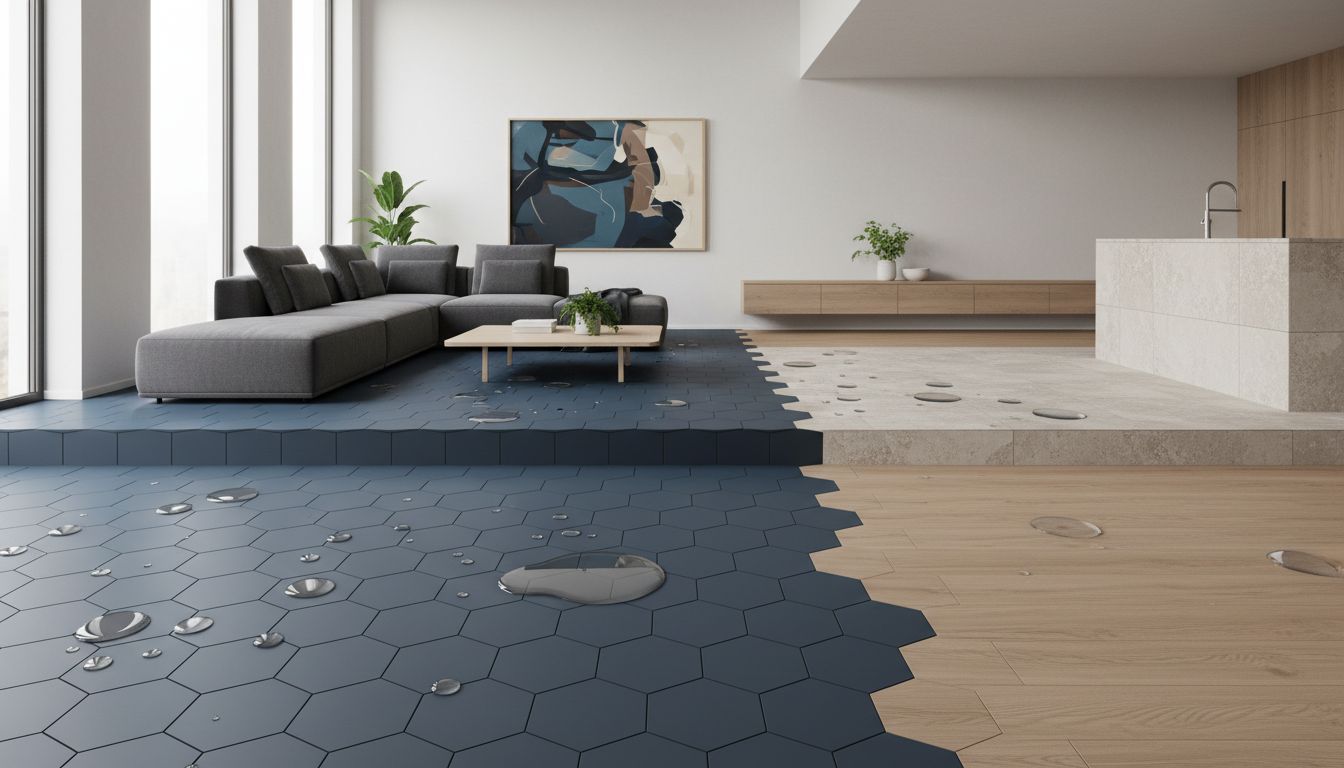
Homeowners and small business owners in New Jersey are noticing a quiet but important change in how surfaces are specified and valued. Rather than prioritizing purely decorative finishes, many clients and designers are now asking whether floors, walls, and façades can help manage water, heat, and maintenance over the life of a building.
That shift, toward connected, waterproof surfaces that perform as part of a home’s climate infrastructure, matters for anyone who cares about long-term resilience in a place that sees coastal storms, high humidity, and sudden heavy rain. As a local flooring and finishing contractor in West Long Branch, NJ, we see these priorities show up in job briefs, warranty conversations, and everyday repair work.
Why resilience now outranks polish
In recent industry coverage, resilience has “emerged as a key consideration” in residential design, and it is no longer treated as an optional aesthetic layer but as a core design brief (ArchDaily, June 10, 2026). For homeowners and small businesses, that means choices about materials and assemblies are being evaluated first for how they reduce risk and support recovery after disruption.
A big reason for the shift is experience: small cracks, poorly sealed transitions, or non-waterproof finishes lead to water ingress, thermal bridging, and structural pathologies that become costly and disruptive. ArchDaily’s reporting in 2025 emphasized that traditional surface failures are still fundamentally about water ingress, reinforcing why water-resistant construction details matter more than purely visual finishes.
The cost calculus is changing. A glossy finish that chips or allows moisture to penetrate is less attractive than a slightly plainer surface that keeps basements, bathrooms, and storefronts dry and serviceable. For NJ properties on or near the coast, making that tradeoff proactively is a practical form of risk management.
Surfaces as climate infrastructure
Design discourse has begun to treat surfaces as infrastructure rather than ornament. ArchDaily described a “network of surfaces” that reflect sunlight, absorb and filter water, sequester carbon, and restore resilience to cities (November 18, 2025). That framing helps homeowners see floors, decks, and paving as active parts of a household’s response to heat, flooding, and pollution.
This is not only conceptual. Permeable paving, reflective coatings, vegetated façades, and integrated drainage channels perform measurable functions: they reduce runoff, lower local temperatures, and limit wear on stormwater systems. In practice, specifying the right surface system can reduce interior humidity, protect finishes, and avoid mold or rot.
For local businesses, surface-based strategies can keep retail floors safe, reduce slips after storms, and lower maintenance costs. Thinking of surfaces as part of a “network” aligns with a broader shift where buildings and their envelopes contribute to neighborhood resilience rather than just acting as isolated objects.
Bathrooms and other indoor proving grounds
Bathrooms have become a proving ground for connected, resilient surface strategies. ArchDaily (April 25, 2025) highlighted bathrooms evolving into environments integrated with intelligent systems,automated fixtures, proximity-activated faucets, and intuitive temperature controls,that also improve water and energy efficiency.
Within a bathroom, waterproofing and connection to monitoring systems make a clear difference. Properly detailed membranes, sealed transitions between tile and fixtures, and sensors that detect moisture or leaks can prevent small problems from turning into major repairs. For homeowners, these systems mean fewer surprises and lower insurance risk.
As systems shift from “smart” to “sensitive,” designers and homeowners are beginning to value environments that respond to human comfort and ecological realities rather than simply display technology. This approach enhances everyday livability and makes waterproof surfaces more than a specification line: they become part of how a home protects occupants and conserves resources.
Rethinking moisture, moss, and living materials
Attitudes toward moisture and organic growth are also changing. Where moss or lichen were long treated as defects, recent work asks whether living materials can be integrated intentionally. ArchDaily’s June 17, 2025 report on living building materials reframes moss and moisture as possible design signals, not just evidence of neglect.
That said, integrating living systems requires careful detailing. Without proper flashings, breathable membranes, and deliberate irrigation or drainage strategies, what starts as an ecological feature can become a maintenance ache or a source of water ingress. The lesson for property owners is that these approaches are promising yet technical, they demand contractor experience and appropriate warranties.
For many homeowners and small businesses in West Long Branch, the practical middle ground is combining low-maintenance, moisture-tolerant materials with selective living elements where they won’t undermine building envelopes. Thoughtful choices let you benefit from ecological integration while minimizing risk.
Adaptability, reversible construction, and dry connections
Another important trend is the move toward reversible and dry-connected construction as resilience strategies. ArchDaily (June 24, 2025) noted that zero-bonding systems and dry assembly techniques make it easier to modify or disassemble components with minimal waste, a strong advantage when climate impacts or changing needs require rapid adaptation.
For interior surfaces and flooring, that might mean specifying floating floor systems, demountable partitions, or sealed yet detachable bathroom assemblies that can be serviced without destructive demolition. These approaches reduce downtime and long-term repair costs, and they fit well with conscientious maintenance plans for commercial and residential properties.
We advise clients to consider reversible details especially in ground-floor spaces and basements where flood exposure or humidity swings are more likely. Combined with robust waterproofing and sensor-based leak detection, reversible systems help properties recover faster after events.
Practical strategies for homeowners and small businesses
Start with a resilience-first checklist: durable membranes, sealed transitions at doorways and fixtures, humidity-adapted finishes, and accessible service points for plumbing and electrics. ArchDaily’s March 11, 2025 coverage stressed that humidity-adapted design is explicitly framed as flood resilience, reserving ground levels for ventilation, drainage, and communal use.
Invest in connected monitoring where it counts: moisture sensors behind floors or under cabinets, smart shutoffs for supply lines, and alerts for unusual humidity spikes. These technologies are most effective when paired with water-resistant surfaces and sensible detailing rather than as stand-alone fixes.
Finally, plan for maintenance. Even climate-resilient surfaces need routine inspection and sealant renewal. Choosing straightforward, serviceable materials and working with a local contractor experienced in waterproofing and finishing ensures that you keep the performance you paid for.
What this means for West Long Branch homeowners and businesses
Local context matters. West Long Branch properties face coastal storm surges, seasonal humidity, and episodic heavy rains. The regional planning and the market are responding by valuing assemblies that “breathe,” move, and can be maintained without full replacement, ideas captured by the “soft architecture” ethos that describes surfaces that “breathe” and “bend rather than break” (ArchDaily, June 4, 2025).
As a contractor serving this community, we emphasize practical resilience: proper substrate prep, tested waterproof membranes, sealed transitions, and client education on what to expect over time. Those elements preserve both property value and daily comfort, which matters to homeowners and small business owners alike.
Where appropriate, we help clients evaluate permeable paving, vegetated edges, and living façades as part of an integrated strategy. These interventions can contribute to neighborhood-level resilience while still delivering a tidy, serviceable finish at the property line.
Designers and homeowners are converging on a clear insight: aesthetic polish is worthwhile only if the underlying assembly protects occupants and assets. As ArchDaily put it, “Designing for resilience means thinking holistically.” Putting performance first keeps repairs down, insurance claims fewer, and businesses open when others face disruption.
Moving from fashionable finishes to connected, waterproof surfaces is a practical adaptation for the climate realities we already see. For property owners in New Jersey, the choice to prioritize everyday resilience pays off in comfort, lower long-term cost, and greater peace of mind.