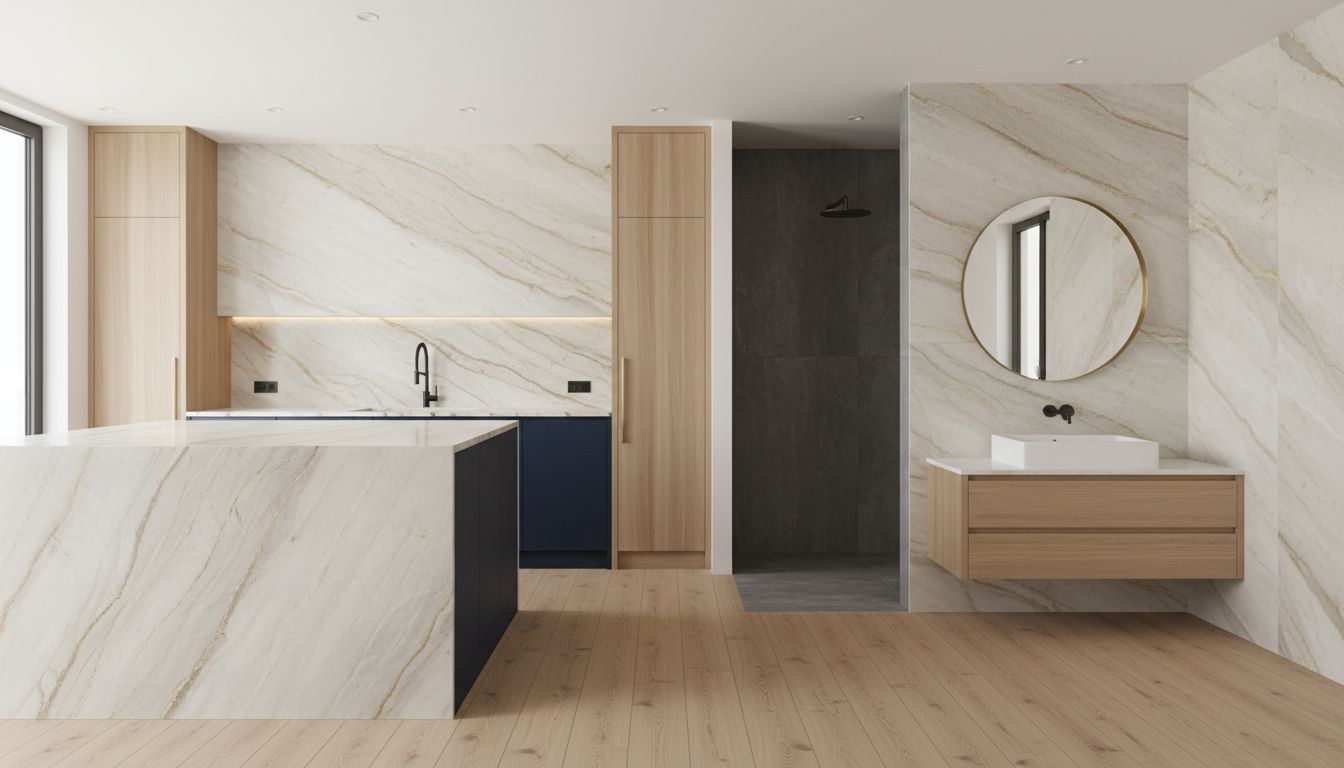
Extra-large porcelain panels are reshaping how homeowners and small businesses think about kitchen and bath design. What started as eye-catching feature walls has evolved into a full planning tool that designers, fabricators, and installers now specify early in projects to achieve cleaner lines, fewer joints, and stronger visual continuity.
For property owners in West Long Branch and across New Jersey, this shift matters practically as well as aesthetically: larger panels can reduce site work, speed up remodels, and deliver durable, low-maintenance surfaces suited to both residential kitchens and commercial settings. Understanding the trends and installation realities will help you make informed decisions about adopting extra-large porcelain panels for your next project.
Why size is the new design lever
Large-format tile is replacing smaller standard sizes in many projects; Tile of Spain notes that 24-by-48-inch formats are increasingly taking over traditional 12-by-24-inch proportions. That momentum has continued into true extra-large panels, where gauged porcelain slabs and panels move from feature elements to primary planning materials.
Manufacturers have responded with ever-larger slabs and thinner gauges. Coverings 2026 showcased slabs up to 72.5″ × 130″ and exhibitors offered 63″ × 126″ panels in 7 mm and 12 mm thicknesses, formats that allow a single piece to cover countertops, splash zones, and vertical surfaces with minimal seams.
The practical effect for homeowners and business owners is significant: fewer cuts, fewer transitions, and a more monolithic look. For local contractors, it also means early material decisions influence layout, transportation, and installation strategies.
Seamless aesthetics: fewer joints, bigger impact
One of the most cited reasons designers choose extra-large porcelain panels is the “fewer joints” mindset. Porcelanosa highlights how large-format walls and bath panels reduce visual interruptions, creating continuous planes that read like stone or concrete rather than tiled surfaces.
Optimum Surfaces and other industry voices emphasize that large slabs can be formed into kitchen tops, islands, backsplash, and custom furnishings from a single piece. The result is a wraparound kitchen design where counters, islands, and backsplashes visually and materially integrate.
For bathrooms, XLIGHT and similar collections enable renovations with minimal demolition; their low water absorption and large-format performance let contractors deliver a refreshed space faster while preserving a consistent, high-end look across floors and walls.
From surface finish to architectural element
Manufacturers are increasingly presenting large slabs as architectural components rather than mere finishes. Tile of Spain and Cersaie coverage document uses that range from clad kitchen islands and integrated bench seating to tiled sideboards and fireplace surrounds.
Designers now treat extra-large porcelain panels as monolithic “furniture,” using slabs to create sculptural, functional elements that alter early-stage kitchen and bath planning decisions. This approach encourages specifying material early, so built-ins and joinery align with slab dimensions and vein-matching.
At trade shows such as Coverings 2026, full-kitchen installations made from single slabs demonstrated the high-impact possibilities, installations that minimize interruptions and prioritize continuous visual flow.
Installation, tooling, and the planning that follows
As the format has grown, panel tooling and installation systems have improved to match. Coverings 2026 highlighted specialized solutions for cutting, transporting, and installing large-format panels safely and precisely, making these materials more accessible to local contractors with the right equipment and training.
However, working with extra-large porcelain panels requires tighter coordination among designer, fabricator, and installer. Coverings and industry coverage note that planning workflows must accommodate slab layout, transport logistics, structural support, and on-site handling to avoid damage and ensure proper seams and anchoring.
For homeowners, that means lead times may shift and upfront consultations are more important. A local, experienced contractor can manage scheduling and coordinate trade partners to avoid costly delays and ensure the finished look meets expectations.
Material standards, product examples, and durability
Minimum-thickness porcelain has become a mainstream architectural category; Laminam positions itself as an early innovator in this field. Manufacturers now offer realistic marble, limestone, and concrete visuals in very large formats, for example, Porcelanosa’s XLIGHT collections come in sizes like 120 cm × 270 cm for cladding and 120 cm × 120 cm for flooring.
Production of large-format porcelain appears to be accelerating. An ASCER survey reported by Tile of Spain found the percentage of large-format slabs produced doubled between 2021 and 2023, reflecting rising demand and manufacturing capacity. Thinner options in 7 mm and 12 mm make handling easier while maintaining high performance.
These materials are durable, stain- and scratch-resistant, and in many cases deliver low water absorption, features that make them well suited to kitchen countertops, bathroom vanities, and wet-area wall cladding while keeping maintenance simple for busy homeowners and commercial operators.
Practical guidance for New Jersey homeowners and small businesses
If you’re in West Long Branch or elsewhere in New Jersey and considering extra-large porcelain panels, start with a local contractor experienced with large-format work. Ask about past projects, whether they have the required lifting and cutting tools, and if they handle vein-matching and edge finishing in-house.
Budget for material, fabrication, and transport, oversized slabs can require special crating and delivery, and allow time for precise templating and coordination with cabinetry or plumbing trades. Proper substrate support, seam placement, and anchoring are critical and can affect overall cost and timing.
Finally, discuss warranty and maintenance expectations. While porcelain slabs are low-maintenance, correct installation and sealed joints are essential for water-prone areas. A reputable local contractor will outline a clear plan for installation, protection, and aftercare so your new kitchen or bath performs well for years.
Extra-large porcelain panels are more than a trend; they represent a shift in how kitchens and baths are planned and built. From seamless surfaces and sculptural islands to accelerated product adoption and improved tooling, the material opens options that were difficult or costly just a few years ago.
For homeowners and small business owners in New Jersey, the key to success lies in early decisions and choosing a contractor who understands the unique demands of large-format installation. Contact a reliable local professional to evaluate your project, thoughtful planning will let you enjoy the visual impact and practical benefits of extra-large porcelain panels with confidence.